AI Slop Is in the Eye of the Beholder
Updated: Jan 26

The more I explore the artificial intelligence and human interaction, the more I see an augmented and interconnected future inseparable from AI. It's a really exciting time to experiment right now and see how it will evolve. For success, humans are integral in this process. There cannot exist a functioning recursive feedback loop. Even with autonomous agents, we direct them (for now I guess), thus our influence is critical for the process. The current manifestations of creative engagement AI (generative, Stable Diffusion) have accelerated and transformed the doing process in getting from point A to point B in an non-linear way. As a creator, tools are available to streamline the product of an idea, reflecting capitalism's insatiable speed of production and consumption. Maybe in its most pure & transcendent form "the idea" can be completely original, but in every practical empirical sense, it's a by-product of an environment and experience. For instance, as a human (for now I guess) I am chronically downloading imagery and sounds from the internet to my brain, which I cannot prevent from soaking deep into my consciousness. I don't even necessarily have consent. This is my forced human training data set.

All that being said, what makes it slop? What makes bad art bad art? These are questions we have never been able to answer definitively, because that isn't how it works. Art is amorphous and beyond time and space. It transmutes these disparate parts into something that then frees itself from our mortal bodies. Art meaning is not defined by the medium, it's defined by the audience. The audience's perception of the work can even dominate an artist's intent and become the central point of meaning. AI has become this new digital color to paint with that many people just plain hate. Any meaning is obfuscated from the art because of the medium itself. I honestly wonder why, when it is actually exactly what everyone has liked. It's a direct reflection of the global masses' preferred brain stimulation. That is how successful training and weighted tokens happen. It's the same thing that makes global pop icons, eye candy music videos and TikTok reels rise to the top of cultural influence and capital. So why the hate?
Perhaps it awakens questions of our capitalistic nihilism we don't know how to face?
As an 'art object of value', it's really up for debate on what makes it bad. That's how it always goes. That's how Warhol got fame and money and fine art is a rich person's game. It's a market that is based on value assigned through rarity and speculation. It's a flex on the capacity to own and shape the exercise of human existence. So I wonder how this next movement, where image markets are flooded, will affect the commerce of the creative industry? I predict it will increase the monetary value of 'fine art', further exemplifying the class difference between the masses and the few. I can see people using AI to sort through the flood of AI, further deepening this gap (will write about this concept in more detail at another time). Fine art will almost be a fetish.

Grimes is an artist looking to expand on these tools and brave enough to experiment in front of the world. There is a vulnerability in treading the unknown, in giving over some agency to your creative work for the greater outcomes. Inspired by her latest initiative to accelerate the relationship between humans and AI, I used her creative domain released #GRIMES AI music to influence my creation of a cyber feminist futuristic world. This is the chaos.
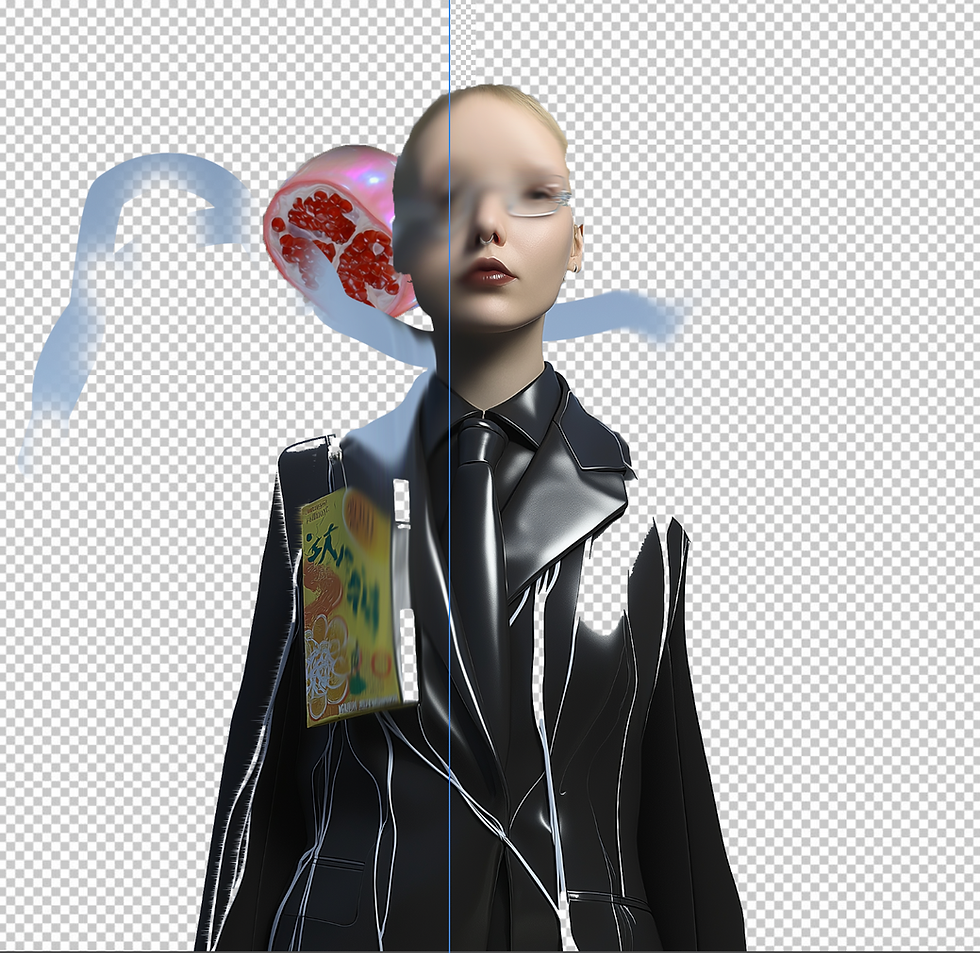
This world is called Dark Star Cyber and is a non-linear short-form narrative exploration that is AI-assisted. I use the tools to generate the digital objects that play out scenes I scripted. I then edit pacing, score, GFX and other things to finalize a product, or I call a 5-20s episode. Each character then becomes a fracture of a fractured stasis. In addition, I am curious to see how the AI operated Youtube algorithm plays a role in the dissemination of this information. What token will get weighted for who's brain?

My first comment was "AI slop doesn't deserve to be on this platform." I wondered... what great meaning was this person looking for swiping through Youtube shorts? Does this mean rage based click bait deserve to be on it? What deserves to be on Youtube? Further more, what constitutes AI slop? Is slop the primitive aesthetic of a generative AI -- an accelerated process of 'creating' based on inputs we all globally have access to and would synthesize in a similar manner with our own brains? Is anything created with AI then by default considered 'slop?' If I had to engage with a Youtube short I didn't like (I wouldn't) I would say -- This is bad, I don't like it... like a movie or any other form of entertainment. For example, I cannot bear a Taylor Swift song and she's literally a billionaire because of her songs. There are also a million generic songs hacked together based on other ones (by humans) and I don't call them music slop. I don't even say it's bad bc that's a relative term, I just don't listen to it. Ah-- perhaps that is the true discomfort. You cannot just turn this off. The line of digital consent feels razor sharp.
This isn't a new exploration of the art + post-social media landscape.
Richard Prince's "New Portrait" series made a giant troll of the art world in 2014. It was a collection of IG screen shots ink-jet printed onto canvases. He didn't do art making. Some people thought it was conceptual art slop and some genius. I think people got mad because they had to look into the mirror, and it's not pretty.

I had a friend that once got a job off craigslist to work for Jeff Koons. He hires people for the doing of his art making. Also, copyright cases are infamously processed in courts regarding the art world and appropriation of images. This chaos is not new. How we are challenging what an image means to us -- when we have and can see almost any image in the digital systems we lack of consent in -- is new.
This post-internet media interaction is in its infancy. One has to get their hands dirty if they want to see where it will go.
SO, I plan on continuing to make AI slop for a platform that prioritizes majority rule --the most likes-- the attention economy. The only distinguishing factor is the non-linear meta narrative of the world I build, its nihilism a reflection of the world we our building. Can one find meaning in it? Or does it disappear like everything else that doesn't capture the most attention of the masses connected to corporate AI algorithms? That is the meaning for me. The mirror eating itself. The irony.


Comments